



The Listening Habit Is Holding
The 2026 CMB Techsurvey suggests that the next gains for Christian radio may come from understanding why listening changes, making station apps more useful, and protecting the trust that listeners place in broadcasters.
The data shows us a useful reminder for Christian music broadcasters: when listening changes, the cause may have less to do with the music or the programming than with the listener’s life.
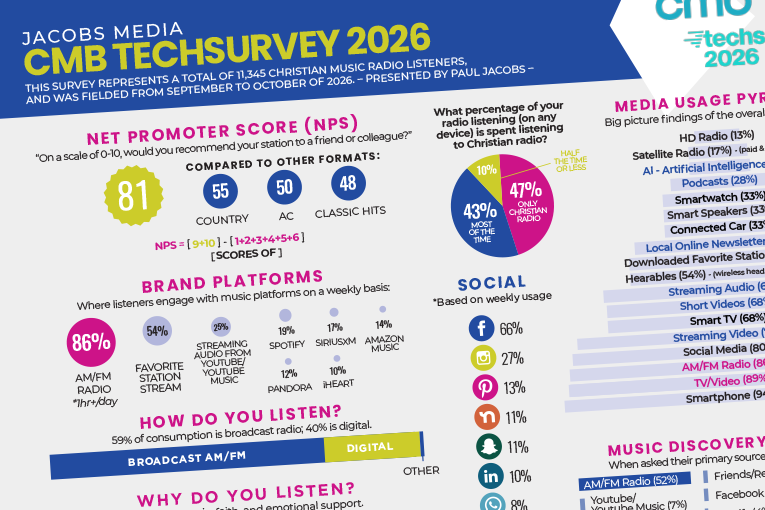
Among respondents who listen to AM/FM radio, most said their Christian radio listening had stayed about the same. A smaller group said they were listening more, while 9% said they were listening to AM/FM less than a year ago. For that group, the leading reasons were lifestyle changes (49%), listening to non-radio sources (43%) and spending less time in a car (42%).
Programming concerns ranked lower. Fourteen percent cited not enjoying the programming, and 14% cited too many commercials. That distinction matters. If a listener’s routine has changed, a programming adjustment alone may not bring back the lost listening time. Stations may need to make the station easier to access wherever the listener is now—at home, on a phone or through a connected car.
The app can be more than a stream
The station app is already serving several purposes. Among respondents who had downloaded their station’s app, 75% said they use it to stream. But 52% use its daily devotional or Bible verse feature, and 51% use it to make a donation.
That’s a significant opportunity for digital strategy. The app can carry the station’s spiritual value into the day, even when someone isn’t actively listening. Features such as devotionals, giving, video and social content can make the app a fuller expression of the station’s ministry.
Push notifications also appear to have a role: 75% said station news or headline notifications were at least somewhat valuable. The practical implication is to send messages listeners have a reason to welcome—useful news, meaningful content or a timely invitation—and to be deliberate about frequency.
Fundraising works best when it protects the relationship
The survey shows that fundraising interruptions can cost stations listening time. Among respondents who said they switch away at least occasionally during a fundraising drive, 60% cited interruption of the music. Repeated messages (41%) and drives that run too long (33%) were also common reasons.
At the same time, listeners gave stations clear clues about what motivates support. The strongest appeal was belief in the station’s mission (69%). Support for a station that reflects the listener’s values and the ability to give any amount each drew 61%.
For broadcasters, the takeaway is not to avoid fundraising. It is to connect the ask to the mission listeners already value, make participation accessible, and pay attention to pacing. A compelling case for support and a thoughtful listening experience need to work together.
The dashboard is another place to serve listeners
In-car listening remains a major part of the audio picture: respondents reported that 61% of their weekday in-car audio time was spent with AM/FM radio. The presentation also points to the dashboard as an increasingly important station touchpoint. Among respondents whose dashboards can display station or music information, 82% said current song title and artist information would interest them. A verse of the day interested 51%.
That’s a reminder that the on-air experience now extends to what appears on a screen. Accurate metadata helps listeners identify a song they love, while faith-centered information can make the station recognizable and useful in the car.
Know who answered—and who may be missing
For broadcasters, the strongest use of Techsurvey is not to treat every finding as a universal audience fact. It is to use the patterns as questions for their own station: Are listeners changing routines? Which app features are they using? Does fundraising preserve the listening relationship? Are digital and in-car experiences building trust?
The data suggests Christian radio’s opportunity is not simply to defend its place in a crowded media landscape. It is to keep showing up in the moments and formats where listeners already find value and to make those connections easier to sustain.
Based on the 2026 CMB Techsurvey