




Radio’s Tectonic Shifts
These days, I think about the major shifts that have impacted our industry. This is in contrast to much of the detail work that used to consume me—the things programmers hear and think about that no one else does. I’m not suggesting the finer points don’t matter, because they are often what separates good brands from great ones. But looking back at radio’s struggle to not just thrive, but to survive, it is hard not to consider those big boulders, the tectonic shifts—the circumstances, the conditions, the decisions that have gotten us where we are today.
In recent weeks with the release of Techsurvey 2026, we have published a lot of updated data about radio’s journey. And because this is the 22nd year Jacobs Media has conducted this national study of core radio listeners, some of these trending reports are absolutely breathtaking, generating comments and theories from all corners of the industry. And some of them are full of vitriol and anger, casting blame for radio’s supposed demise in lots of different directions.
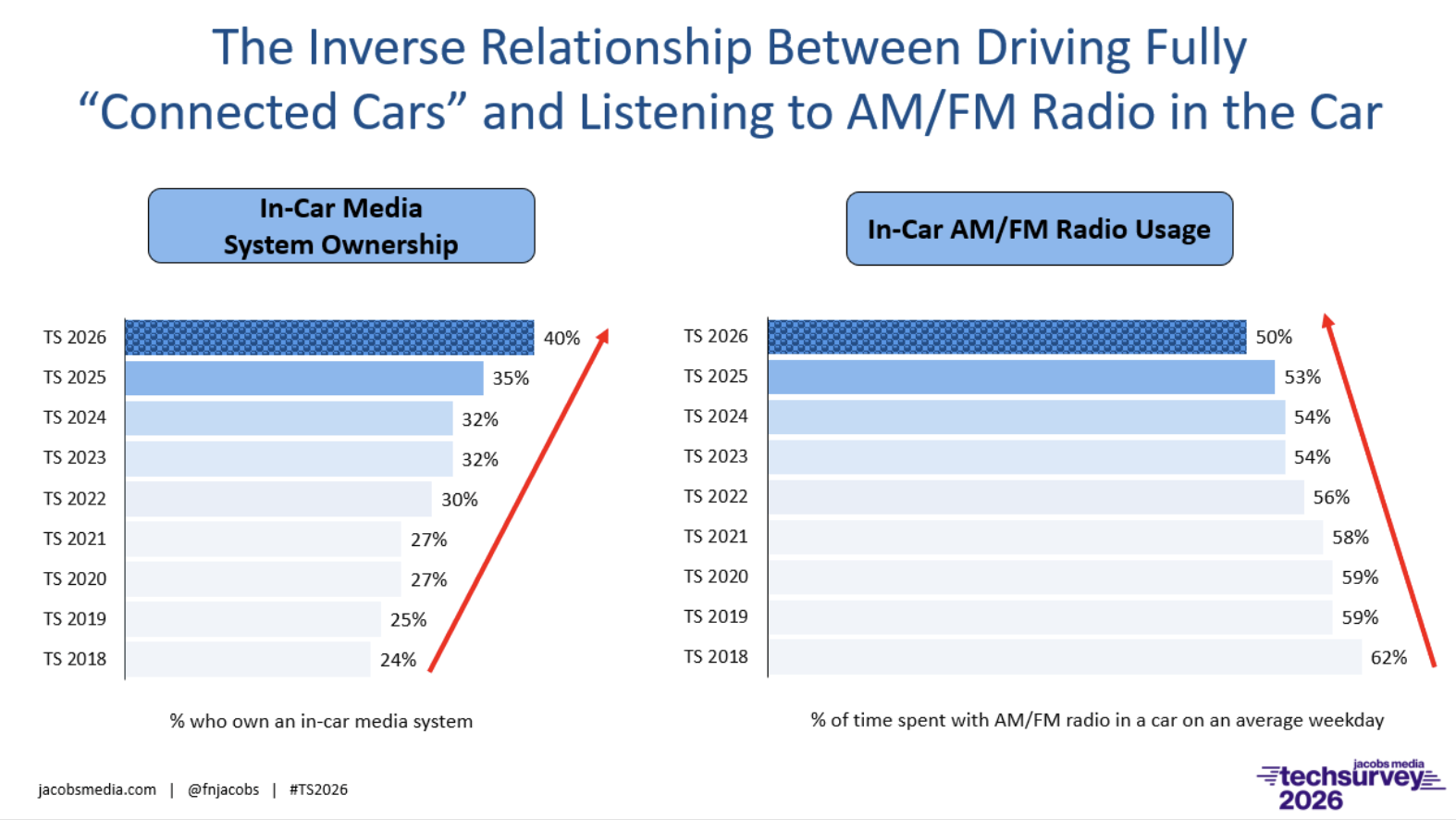
The chart above, for example, should make everyone in radio—from corporate execs to the part-time voicetracker—hit the brakes. This year in TS 26, we set a new record for “connected car” ownership. Now, four in ten respondents (40%) drive these vehicles. You can clearly see how having more in-vehicle options while driving has impacted radio listening. Given that even entry-level vehicles are now “well-connected,” this trend will only accelerate as consumers replace their older cars, SUVs, and trucks.
So, how do we think about radio’s future, amidst challenging financial quarters, companies flirting with bankruptcies, and mega-mergers on the horizon?
First and foremost, I am of the belief that radio has many more chapters ahead of it. They may end up being different from the past stories of glory and they will undoubtedly star a different cast of characters (myself included). On the face of it, this is a healthy circumstance. But as new leadership emerges, it may be helpful for them to have a strong grasp of how radio got here. And even better, how a newly imagined radio platform can avoid the speed bumps, sand traps, and most certainly the black holes that have characterized many past missteps.
That means studying the past few decades to not only identify some of the root causes of broadcast radio’s travails, but to also provide a hierarchy—identifying the most impactful events, circumstances, and decisions that have disrupted the industry over these years.
Today’s blog post is wonkier than most. And I purposely posted it on a Friday to provide for the possibility of some weekend reading and processing. When you consider some of the tectonic shifts that have most affected the health and well-being of the broadcast radio industry over these many years, it turns out there are many factors at play.
Enter Robert Minton. We may have crossed paths at one point or another, likely while both of us were working with WIMZ in Knoxville. But as I’ve learned, Robert’s background is more diverse than most of us who have spent the prime of our lives in one form of radio or another.
Robert’s career accomplishments include national network strategy, sponsorship, promotions, audience development, SaaS, and agency operations. He has been in leadership positions with Disney, the ABC Radio Networks, and Citadel Media among others. As he explained to me, Robert has focused on developing “a broader view of how technology, agencies, brands, and audience behavior have reshaped the media business.”
JacoBLOG readers know I am fascinated by these big picture analyses of where we are and how we got here. The work of Evan Shapiro and his dynamic media maps have been featured here numerous times over the years because they help our broader understanding of radio’s place in the media and entertainment universe.
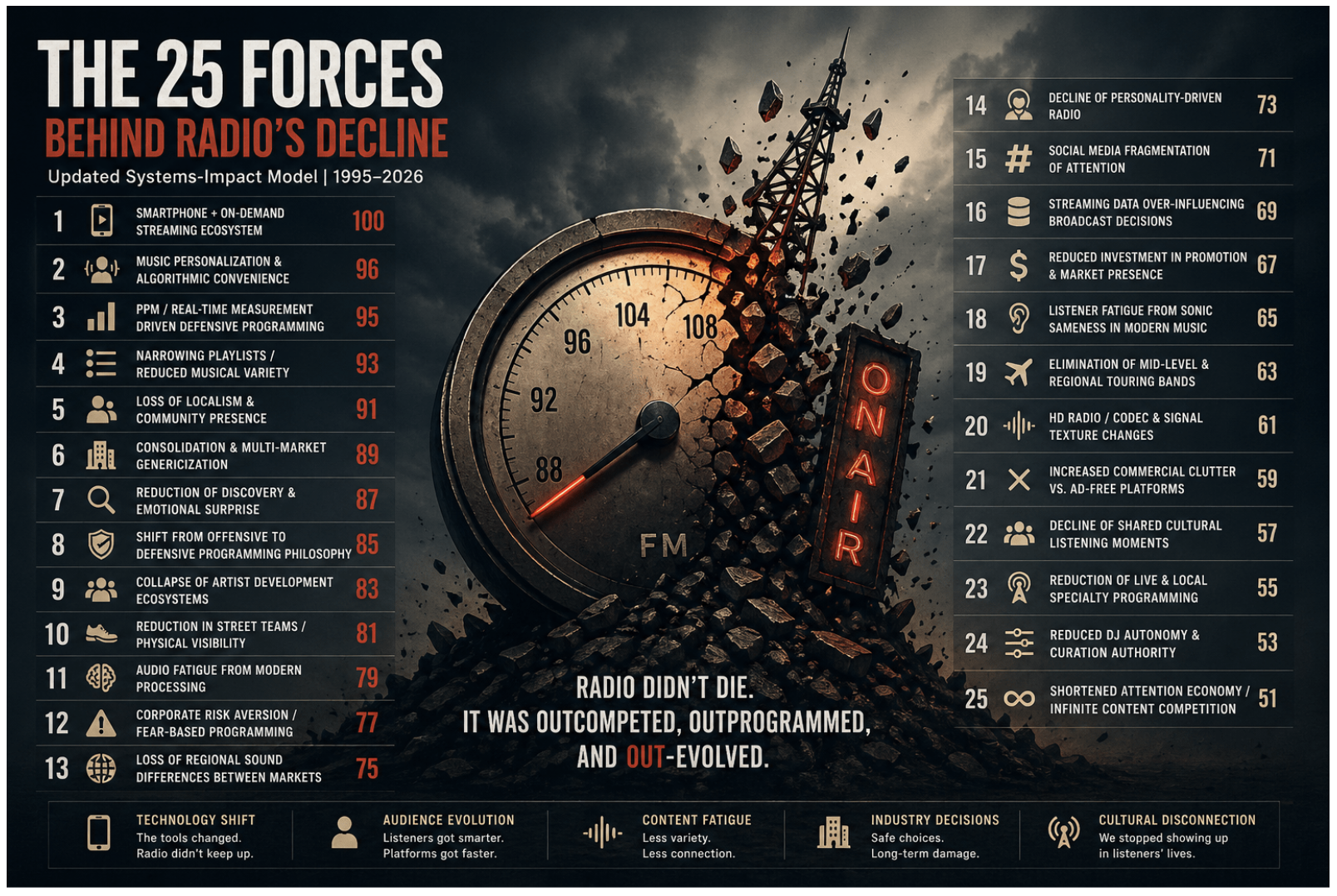
Robert reached out to me earlier this week with a chart and lots of theories. His premise is to list the factors that have contributed to the diminishment of broadcast radio over the years, and create a hierarchy of their importance. In other words, what has been the relative rank of their impact on the industry? Which of these tectonic shifts are the true “smoking guns?”
The version he sent me (posted below) is an update on the original, leaning harder into the premise that radio’s rough patch hasn’t just been due to tech disruption (i.e., the smartphone, streaming, satellite radio, podcasts, etc.) but also to “self-inflicted wounds” that include some of the following policies and factors:
- the loss of emotional differentiation
- the weakening of local identity
- defensive programming strategies and behaviors
- reduced novelty and discovery
- sameness fatigue
- the erosion of companionship and community feeling
Robert’s new model also places greater weight on the following:
- locality
- playlist narrowing
- discovery reduction
- artist ecosystem collapse
- physical market presence
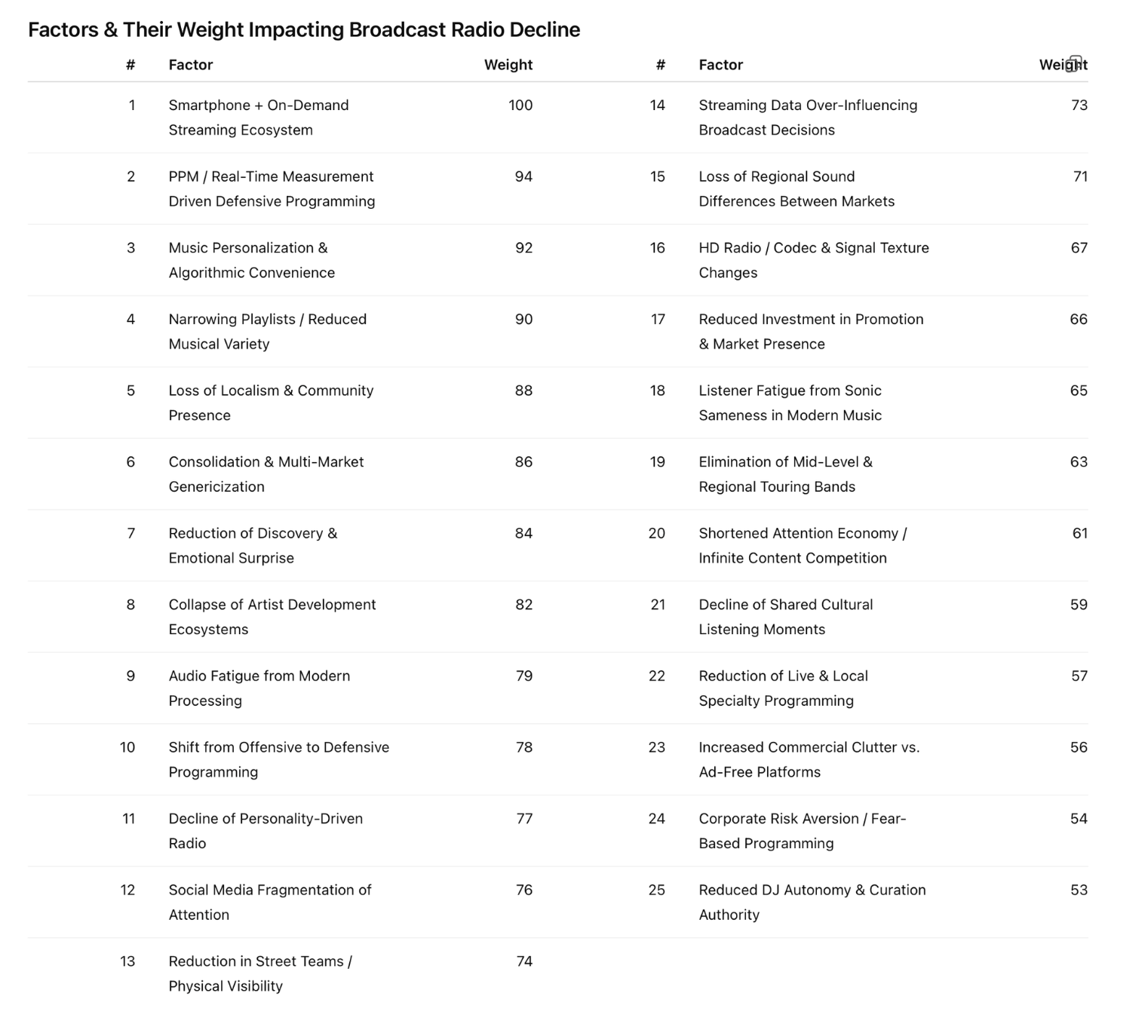
These are indices, so the closer to 100, the greater the impact on the radio industry. Robert didn’t just assign these numbers via gut. He has developed an elaborate “methodology” that shows his work and his thought process. I’ve linked it here.
So, on the one hand, digital disruption gets the most weight (blame) for negatively impacting radio, while “reduced DJ autonomy & curation authority” earns the least impact (of those included) in radio’s big picture.
What’s missing from Robert Minton’s list of tectonic shifts? I wonder about the external global factors that have taken their toll on the radio broadcasting industry, and where they might fit into the above group of “culprits.” The “Great Recession” of ’08/’09 comes to mind, as does COVID and its impact on lifestyles, media consumption, and commuting patterns. And is it too early to start factoring in AI to Robert’s weights and measures?
I also believe sweeping changes in automotive dashboard technology belong on Robert’s list. Tectonic shifts in the auto industry impact radio’s future. As our Techsurvey 2026 chart above clearly shows, there appears to be a relationship between the proliferation of “connected cars,” and slipping time-spent listening to AM/FM radio in vehicles. Considering the car is still the #1 listening location for radio, this strikes me as a key factor.
Whether you agree or disagree with Robert Minton’s premise, choices, and methodology, his work aims to frame the conversations taking place every day in and out of radio circles. As he noted when he first sent me his materials, his work would make for a great “super session” at a conference where perhaps a “town meeting” style discussion could be moderated to lend more clarity to where we’ve been, and how the medium can best progress.
I hope this post is the start of those conversations—within companies, on social media, and throughout broadcast radio’s many organizations.
The world may be shifting underneath our feet. But understanding these quantum changes and factoring them into our future strategic work can produce better outcomes for radio.
Thanks to Robert Minton. Chris Brunt created a stylized version of his chart (below):